Past Research
- Past Research
- VR System for Improving Social Skills in Teenagers with Autism
- Robot-mediated Response to Joint Attention System for Children with Autism
- Robotic intervention platform for older adults with mild cognitive impairment and dementia
- Collaborative Virtual Environments
- Social interaction skills tutoring using collaborative Augmented Reality (AR) environment for children with ASD
- Assistive avatar in virtual reality puzzle game to improve eye gaze perception in children with ASD
- Physiology-based Dynamic Difficulty Adjustment Driving Task
- Intelligent Agent
- Physiological Data Processing and Physiology-based Emotion Recognition
- EEG-based Affective Computing
- Cognitive Load Measurement
- IntelliCane: Intelligent Walking Cane System
- Tactile Stimulation Device
- A Haptic Virtual System for Improving Fine Motor Skills in Children with Autism Spectrum Disorders
- Teddy Bear Robot
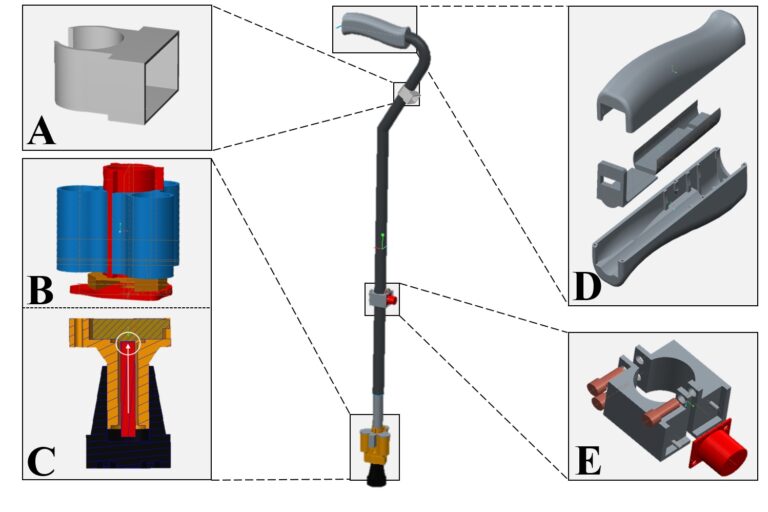
Personnel:
Joshua Wade, Harrison Yan, Robert Boyles, Kevin Zheng
Goals/Objectives:
- Extend mobility assessment beyond the clinical setting
- Create new measures to assess fall risk in mobility aid users
- Augment current clinical practice by providing objective measures of mobility characterization
Outline:
Much of the state of the art in mobility assessment that Physical Therapists (PT) use to provide therapy for their patients is based on observational measures. Although many of these assessments (e.g., Functional Gait Assessment, or FGA) are evidence-based and demonstrate strong inter- and intrarater reliability, they are characterized by low resolution and are subject to human error. Such instruments may be easily augmented by an instrumented electronic system to provide objective quantitative data that can be used by PTs to design better therapy plans for their patients. For over 200,000 PTs practicing in the US, such an instrumented tool could be an invaluable asset in the clinic. Moreover, people with mobility impairments (+8.5 million in the US) may themselves benefit from using an instrumented tool at home because it has the ability to produce long-term data logs, which could then be conveniently analyzed by PTs interested in monitoring at-home compliance and progress.
At present, the IntelliCane is being tested with a patient population in collaboration with our partners at Vanderbilt Medical Center’s Pi Beta Phi Rehabilitation Institute. Patients of Pi Beta Phi use the IntelliCane during therapy sessions, producing a large amount of sensor data from real-world evaluations. This information is then analyzed by our researchers to create predictive models of user activity and functional mobility, as well as to provide important objective metrics to PTs regarding their patients’ performance. Future development of the IntelliCane will consist of refinement of the software and algorithm design with a focus on privacy, security, scalability, and user-interface.
Publications & Patents:
- Wade, M. Beccani, A. Myszka, E. Bekele, P. Valdastri, P. Flemming, M. de Riesthal, T. Withrow, and N. Sarkar, “Design and implementation of an instrumented cane for gait recognition,” in IEEE International Conference on Robotics and Automation (ICRA), 2015, pp. 5904-5909.
- Sarkar, T. Withrow, and J. Wade, “IntelliCane,” in Southeastern Medical Device Association (SEMDA), Atlanta, GA, 2015.
- Sarkar, T. Withrow, and J. Wade, “IntelliCane Instrumented Therapy System,” in Southeastern Medical Device Association (SEMDA), Nashville, TN, 2016.
- Flemming, J. Wade, M. de Riesthal, and N. Sarkar, “Utilization of an Instrumented Cane in a Neurological Physical Therapy Clinic,” in Combined Sections Meeting (CSM), San Antonio, TX, 2017.
- Sarkar, T. J. Withrow, J. W. Wade, R. Boyles, A. Myszka, E. T. Bekele, and M. Beccani, “Walking aid and system and method of gait monitoring,” United States Patent Application 15/068,317, 2016.