Our Research Project
Flexible encoding of multiple task dimensions in human cerebral cortex
Introduction: Cognitive models have proposed that behavioral tasks can be categorized along at least three dimensions: the sensorymotor modality of the information, its representational format (e.g., location vs. identity), and the cognitive processes that transform it (e.g., response selection). Moreover, we can quickly and flexibly encode, represent, or manipulate information along any of these dimensions. How is this flexibility in encoding such information implemented in the cerebral cortex?
Methods: To address this question, we devised a series of functional magnetic resonance imaging (fMRI) experiments in each of which participants performed two distinct tasks that di ered along one of the three dimensions.
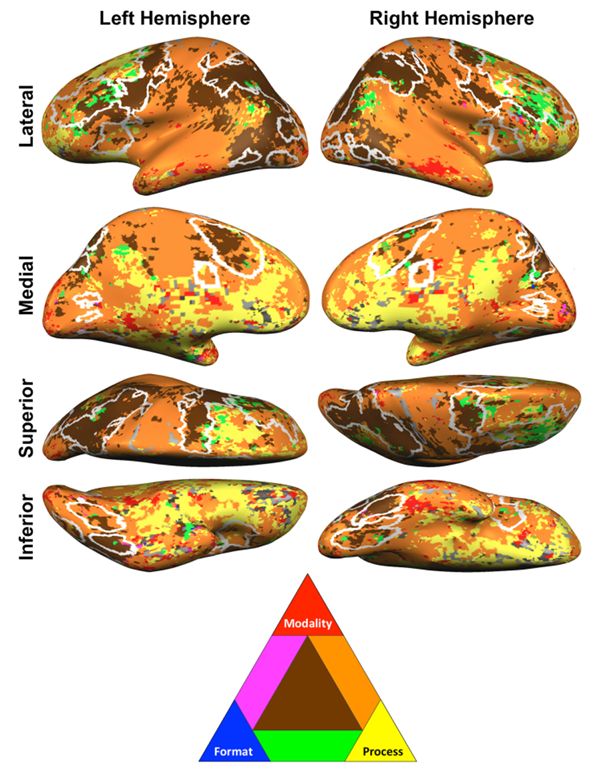
Results: Using multivariate pattern analysis of the fMRI data, we were able to decode between tasks along at least one task dimension within each of the cortical regions activated by these tasks. Moreover, the multiple demand network, a system of brain regions previously associated with flexible task encoding, was largely composed of closely juxtaposed sets of voxels that were specialized along each of the three tested task dimensions.
Discussion: These results suggest that flexible task encoding is primarily achieved by the juxtaposition of specialized representations processing each task dimension in the multiple demand network.
- Tamber-Rosenau, B. J., Newton, A. T., & Marois, R. (2024). Flexible encoding of multiple task dimensions in human cerebral cortex. Frontiers in Cognition, 3, 1438390. doi: 10.3389/fcogn.2024.1438390. [PDF]