Our Research Project
Serial Queuing of Information Processing in the Human Brain
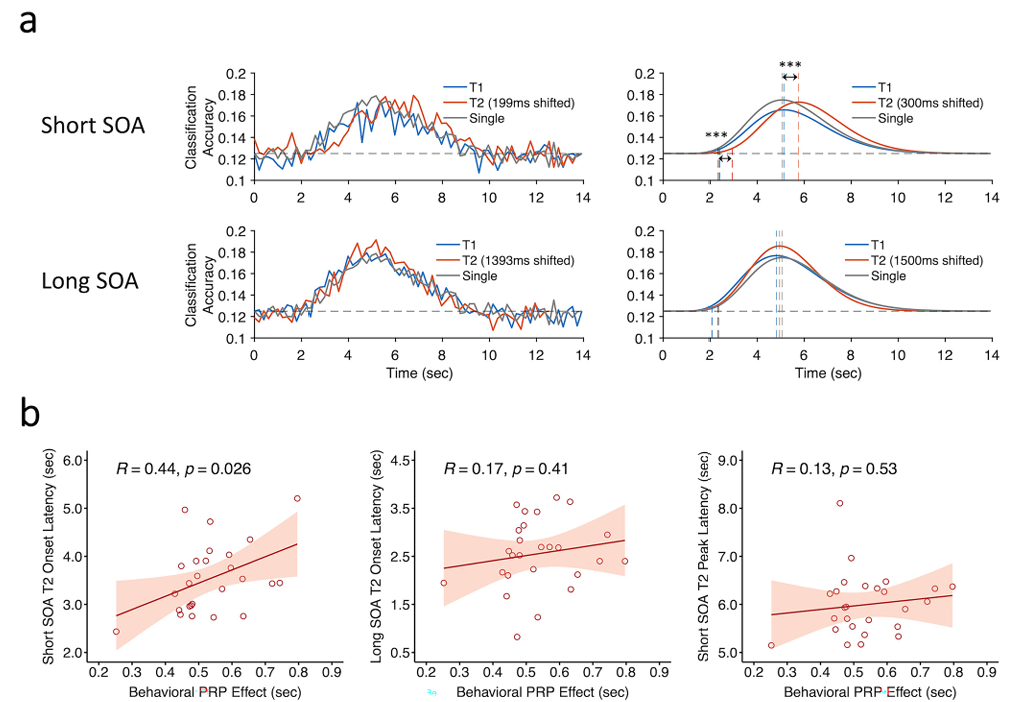
The human brain is heralded for its massive parallel processing capacity, yet influential cognitive models suggest that there is a central bottleneck of information processing distinct from perceptual and motor stages that limits our ability to carry out two cognitively demanding tasks at once, resulting in the serial queuing of task information processing. Here we used ultrafast (199 ms TR), high-field (7T) fMRI with multivariate analyses to distinguish brain activity between two arbitrary sensorimotor response selection tasks when the tasks were temporally overlapping. We observed serial processing of task specific activity in the fronto-parietal multiple-demand (MD) network, while processing in earlier sensory stages unfolded largely in parallel. Moreover, the MD network combined with modality-specific motor areas to define the functional characteristic of the central bottleneck at the stage of response selection. These results provide direct neural evidence for serial queuing of information processing and pinpoint the neural substrates undergirding the central bottleneck.
- Yue, Q., Newton, A. T., & Marois, R. (2025). Ultrafast fMRI reveals serial queuing of information processing during multitasking in the human brain. Nature Communications, 16(1), 3057. doi: 10.1038/s41467-025-58228-0. [PDF]