Teaching Communication: Instructional Strategies for
Minimally Verbal Students with ASD
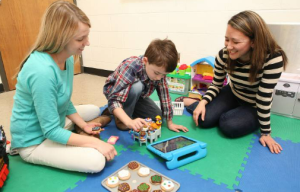
Setting up the environment to promote communication
- Be at the child’s level and across from them: so you can catch fleeting eye contact and encourage it with a positive social response.
- Notice what they are interested in and join in the activity, and be readily available to play and respond
- Remove distractions: this can help the child understand what to do with the materials and reduce stereotypical behavior
- Use with toys/materials that the child is already familiar and/or successful with
- Choose high priority or fun activities, so that the child is more motivated to interact and doesn’t have to try to figure out how to play
- Give choices, change with the child’s interest, be prepared to be flexible.
What you can do as an adult communication partner and teacher
- Be a communicator and an activity partner: join in, connect, share, be with the child
- Reduce demands by eliminating most (if not all) instructions and questions (WH, y/n). We want the child to see us as fun and engaging, not as a work or demand situation.
- Respond to all vocalizations, words, gestures, eye contact, iPad use in an excited way by either repeating/imitating the child and adding a point or by adding a word to what the child said and adding a point.
- Model language at the child’s level (target), include iPad and a point if possible, making sure the models are paced (don’t pause for longer than 20 secs, but do wait 5 secs between statements). This gives the child time to hear you and process the information.
- Use concrete nouns and verbs, with a good amount of repetition but enough diversity to teach new words/concepts.
- Imitate what the child is doing and label it with a word and a point, this helps us choose the right words to use, makes our language models more salient, and makes us pay attention to what the child is interested in
- Our intervention revolves around what the child wants to do and most of our work is done by how we model language and respond to any social communicative attempt. We save active teaching (Time Delays and Milieu language prompting) for times when the child is naturally motivated (requesting) to tolerate the demand.
- The use of models and expansions, joining play and expanding it, showing how to be a communicator and responding as partner all fit together in the process of supporting and (in behavioral terms) shaping the child’s behavior toward communication, longer engagement, and more responsive social interaction.
- It’s the process that “buys” you opportunities to teach…. Building engaged, fun interactions, making communication easy, building a relationship with the child opens up the possibility of modeling, prompting, shaping, reinforcing communication.
Using iPads as communication devices
- Program with a consistent format: for example move from left to right, in a subject verb (attribute, preposition) noun sequence
- Use real pictures for nouns when possible
- Reduce the size of the field of icons. Start with a small set of icons and add more icons as the child is successful
- If possible, whenever you model language, say the word and then push the corresponding icon on the iPad to provide lots of AAC models
- If possible, whenever you respond to the child’s communication, respond back with the word and then push the corresponding icon on the iPad to keep AAC responses at a high rate
- It is important that YOU communicate using the iPad (make comments and respond to the child) this teaches the child to use the iPad to comment, not just request.